Published in Heated
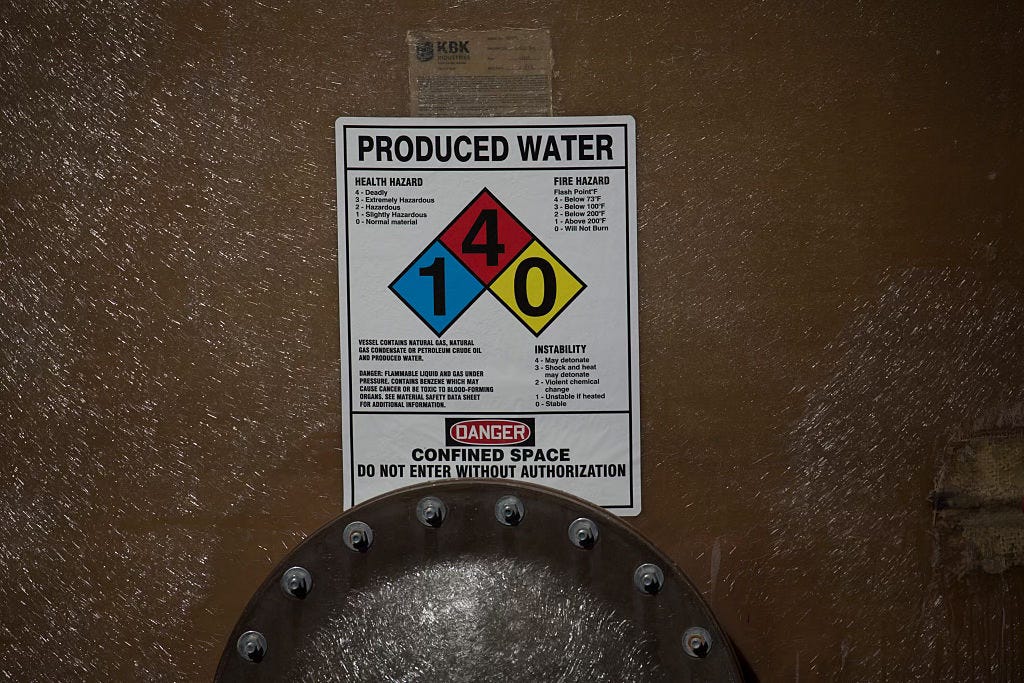
Sometime in the next few months, Texas is set to issue its first permits letting the oil industry pour treated fracking wastewater into rivers and onto cropland.
Five applications are currently pending, covering more than 18 million gallons of wastewater per day, all bound for the Pecos and the Atascosa Rivers. The company furthest along expects approval by the end of the year. The Texas environmental regulator is also actively working on the rules that would allow oilfield waste to be sprayed on cropland.
It may sound crazy to dump treated fracking waste on land that is used to grow food, or into waterways connected to drinking water supplies. But last month, oil and gas industry representatives gathered before the state Senate to explain why they desperately need to do exactly this.
In doing so, they inadvertently gave the public a free lesson in how to bring the U.S. oil and gas industry to its knees.
Wastewater: The oil industry’s achilles heel
What happens in the Permian Basin over the next few years will help determine how hot the planet gets. The Permian, which sits under West Texas and southeastern New Mexico and produces about half of all American oil, is a vast flat landscape of endless pumpjacks and burning flares that has been unfavorably compared to Mordor. It is currently on track to become the single biggest source of climate pollution on Earth.
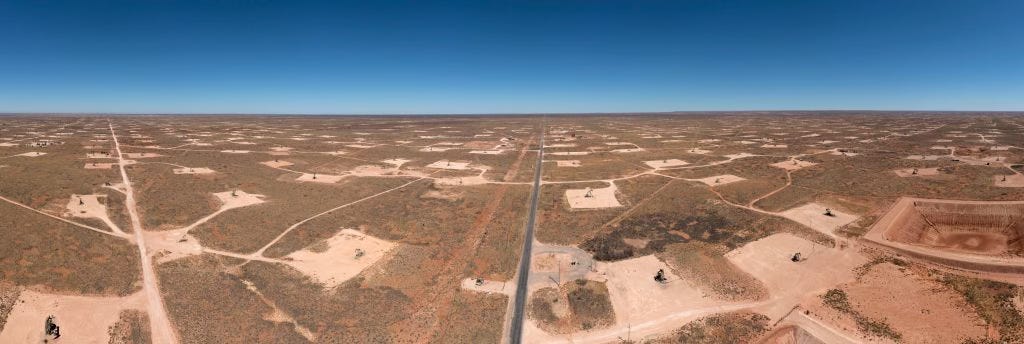
But producers in the Permian are running into a serious problem: They are running out of space to dispose of their toxic, often radioactive wastewater, often called “produced water,” which comes out of the ground at about four times the rate of every barrel of oil.
The Permian brings up nearly a billion gallons of this wastewater every day. In addition to being as much as 10 times saltier than the ocean, this wastewater often contains organic carcinogens like benzene; naturally-occurring poisons like arsenic and cadmium; radioactive isotopes like radium; as well as new human-made poisons like PFAS, or forever chemicals.
To dispose of it, producers have historically injected it back underground—a process that has caused a set of problems like earthquakes serious enough to crack home foundations, and toxic water bubbling out of the Earth.
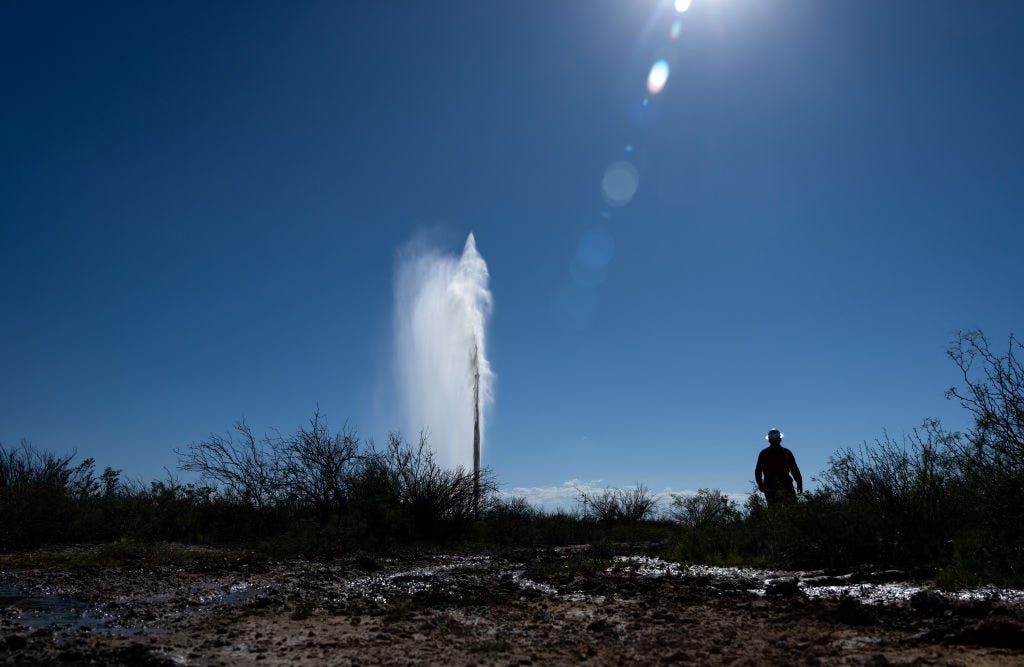
But the space to inject produced water underground is running out. “We’re basically trying to stuff 20 ounces of fluid in a 12-ounce can,” as Jim Wright, chairman of the Texas Railroad Commission, told Texas lawmakers in a hearing last month. “Pretty soon, that’s not going to work very well.” (The Railroad Commission is, despite its name and the many calls to change it, the state oil and gas regulator.)
To solve this problem, the industry representatives are proposing a new, big business of treating fracking wastewater to make it less toxic, then pouring it directly onto cropland and into waterways. Michael Lozano, who represents Permian Basin producers, pointed to projections that oil and gas producers could invest $156 billion into such “reuse” by 2030, including a new network of pipelines and treatment facilities.
Industry representatives are promoting produced water as a safe new resource, portraying the science as settled. “We know this can be done safely, effectively, and robustly to ensure that we’re creating and taking full advantage of this new water source that has not existed for our human species for 10,000 years,” Lozano said. They’ve pointed to an August study that used treated produced water to grow alfalfa, a common cattle feed, as proof.
But that study’s own authors have urged caution. They wrote that long-term research is needed to assess the practice’s cumulative effects on soil, plants, and microbial communities. Civic and environmental organizations also argue there is scant evidence that industry can treat produced water at anything close to the cost or scale it promises. Their concern is not simply whether water can be cleaned in a laboratory or a pilot project, but whether Texas’s standards will require treatment rigorous enough for widespread reuse. Under proposed state rules, treated produced water would be regulated no more stringently than municipal sewage.
Critics have a concrete reason to fear that outcome: Texas has already moved to make sure the industry won’t have to pay for damage if the experiment goes wrong. Last year, the Texas Legislature passed H.B. 49, a law giving any company that buys, uses, treats or discharges produced water a near-total shield from legal liability if the waste harms people, livestock or property.
It’s no surprise, then, that this proposal is very unpopular across political lines. For example, in my own reporting on a Texas elementary school built on a dumping ground for untreated waste from gas drilling—a case I later discussed with HEATED—I heard rock-solid Republicans voicing concern that Gov. Abbott planned to “put fracking fluid on our food.” A Future Heist analysis of comments on the proposed rule found virtually unanimous opposition.
Still, oil industry representatives are trying to push the proposal through—because if they don’t, they warn, they won’t be able to keep drilling.
“If the water cannot move, the oil cannot flow,” produced water lobbyist Trace Finley warned at the hearing.
Republican state Senator Tan Parker was even more blunt. If they didn’t approve permits to dump treated fracking wastewater onto crops and into rivers, he said, “we’re going to find ourselves in two or three years with a gun to our head.”
Without meaning to, Parker had just told his opponents exactly where to apply pressure.
They key to stopping Permian drilling: Mobilize against wastewater permits
At the August hearing, oil and gas industry representatives warned Texas leaders that their plan for American energy dominance had a critical bottleneck: permits.
The Texas Commission on Environmental Quality (TCEQ), the state’s environmental regulator, is responsible for granting permits governing how produced water is treated, put on crop fields, and dumped in rivers. That agency began reviewing applications “nearly three years ago,” oil regulator Wright complained. But “to date, no final permit has been issued.”
The reason for the delay, according to the TCEQ, is that it’s taking its time to do the science properly. But the oil industry is pressuring them to move quickly—and they have support from powerful friends.
For the Trump administration, Sen. Parker told the committee, there is “no higher priority than produced water.” The Trump EPA is weakening water protection rules with the explicit goal of “unleashing” oil and gas, floating the idea of using treated fracking waste for everything from rangeland irrigation to cooling AI data centers.
That is to say: Stopping this machine will not be easy. Both the Trump Administration and Texas’s Republican leadership is all-in on a policy almost nobody who has weighed in wants. As Parker put it: “You’re never going to have an environment where you have a legislative process, a governor, lieutenant governor, more supportive of this.”
The opposition movement will also have to seriously reckon with jobs. Roughly a quarter million people work in the Permian, where oil and gas remains the economic engine. Its jobs are dangerous and increasingly threatened by automation, but they offer something rare: a middle-class life without a college degree. Any serious move beyond oil must offer comparably paid alternatives.
But the wastewater proposal offers no lasting future. It makes drilling-dependent communities absorb the industry’s toxic waste to sustain rising production, even though avoiding the worst climate outcomes requires fossil fuel use to fall. Finding somewhere new to dump the waste only postpones the question of what comes next.
This is an area where the incentives of the climate movement, public health and conservation groups, ranchers and landowners, and anyone interested in human and environmental health—MAHA Moms included—align. The industry’s plan for survival requires moving fast. The chance to slow it down is there for anyone willing to tell an electorate already watching bulldozers roll through Big Bend National Park that these men have literally trashed Texas—and are proposing to trash it further. And to say, instead, that it may be time to clean the place up.
How to fight Texas wastewater permits
All five Permian discharge applications—for the Pecos River basin—are currently under TCEQ review and comments are open now. You can submit comments or request a public meeting through TCEQ’s eComment site, using these permit numbers.
- NGL Water Solutions Permian (Reeves County) — #WQ0005445000 — Proposed permit details —
- Solaris Water Midstream (Reeves County) — #WQ0005471000 — Proposed permit details —
- Solaris Water Midstream No. 2 (Culberson County) — #WQ0005474000 — Proposed permit details —
- Texas Pacific Water Resources (Reeves County) — #WQ0005454000 — Proposed permit details —
- Select Water Solutions (Reeves County) — #WQ0005495000 — Proposed permit details —
Readers living in Texas can also subscribe to TCEQ’s permit notices, which allow Texas residents to get notice of projects planned for their zip code—or monitor its long list of pending wastewater permits.
Anyone can comment, but those who are directly impacted by these discharges—downstream landowners, irrigators, water users, and people who rely on the Pecos—can go further. If enough write in, they can push the agency into a contested hearing—a trial-like proceeding where they can challenge the permit’s facts. And if they’ve commented, they can establish the standing to challenge a project in court.
At some point in the coming months, the agency will start issuing draft permits, which will start a 30 day counter, after which comment will close.
For those who are impacted, environmental advocates say, the key things to do are are:
- Taking good records of how you use the affected waterway for business, recreation or irrigation
- Commenting within 30 days of the issuance of a draft permit to establish standing, and
- Getting organized before the permits drop, because once they do, things move fast.
Veterans of this process emphasize that the odds of successfully getting a permit denied or revoked are low. But contested hearings, court battles and local comments form a broader drama of local democracy that can sway elected officials, persuade companies to seek greener pastures, and become grist for electoral or legislative efforts at reform—as the grassroots campaigns against data centers have shown.
If you or someone you know relies on water near the proposed discharge sites, owns or works affected land, irrigates downstream, or has information that could help document the risks, contact Future Heist. We can help connect people with public-interest environmental lawyers following these cases.